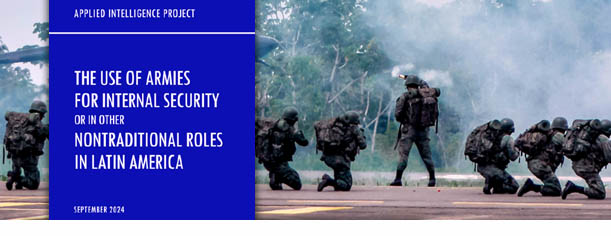
The CIB has published a new report on the unorthodox use of militaries in Latin America, which was commissioned by the United States Army’s National Ground Intelligence Center (NGIC). Formed in 1994 as part of the Army’s Intelligence and Security Command, NGIC provides general military intelligence, as well as specialized scientific and technical intelligence on foreign ground forces. It shares its products with the Department of the Army, the Department of Defense, and various other national-level decisionmakers
Entitled “The Use of Armies for Internal Security or in Other Nontraditional Roles in Latin America”, the report (PDF) is the product of a semester-long open-source research project that was conducted by the CIB’s Applied Intelligence Project.
The report points to the presence of organized crime as the primary driving factor for domestic military use in countries such as Mexico, Venezuela, El Salvador, Honduras, Brazil, Peru, Bolivia, and Ecuador. Moreover, it describes how political instability resulting in protests or riots has led to multiple cases of internal military use to facilitate the political policing of civilians. Furthermore, a host of governments in Latin America have used state of emergency declarations to maintain internal security. This is likely due to the lack of adequate police power, which is supplemented with military assistance.
The 40-page report also looks at the rate of modernization of military technology and the allocation of resources in Latin American militaries, which allows for a wider distribution of domestic military use. This includes extensive military uses for environmental protection and for civilian transit functions. Lastly, the report examines the role of outside state actors, such as China and Russia have invested militarily in the region, with China making concerted efforts to strengthen diplomatic ties and advance its Belt & Road Initiative.
The report was authored by Critical Mission Center directors Joshua Koval and Megan Marsh. The National Security Implications section was authored by Senior Analyst Samuel Luckett and the Challenges and Opportunities section was authored by Senior Analyst Lilyanne Sweat. Ryan Lindsey (Deputy Director), Nevaeh Deichert (Deputy Director), Connor Andersen, Ryan Ignacz, Ryan Kelly, McKenzie Shakespeare, Nicholas Utermahlen, Christopher Brophy, Madison Conway, Jack Fruscello, and Preston Martz, served as Senior Analysts on this project. Alejandro Olivares served as a Quality Assurance Officer. The editorial overview and supervision was conducted by CIB Faculty Mentor Dr. Joseph Fitsanakis and CIB Executive Director Tessa Bentley.
The CIB wishes to thank NGIC Intelligence Analyst Kyle Brossard and Analytic Outreach Manager Jamie Cruz, of NGIC’s Analytic Tradecraft Advocacy Cell. Generous funding for this project was provided by the Thomas W. and Robin W. Edwards College of Humanities and Fine Arts and the Center for Applied Intelligence at CCU.
 CIB
CIB 